Search Results for "silvia silly a lhe cunar diverdade"
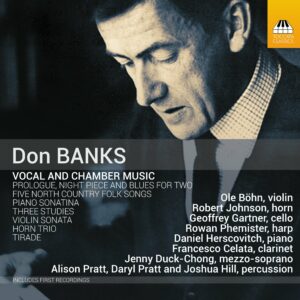
Don Banks: Vocal and Chamber Music
During his short life Don Banks (1923–80) enjoyed a reputation as the leading modernist among Australian composers. Studies with Mátyás Seiber, Milton Babbitt and, especially, Luigi Dallapiccola helped refine his serial technique, but his music never retreated into academic abstraction, as this recital of chamber and vocal works demonstrates: it retained a keen sense of drama, an ear for atmosphere, a rather angular lyricism and, occasionally, a touch of humour.
Robert Johnson, horn (Tracks 1–3)
Ole Böhn, violin (Tracks 1–3, 18)
Jenny Duck-Chong, mezzo-soprano (Tracks 4–8, 19–21)
Francesco Celata, clarinet (Tracks 9–11)
Geoffrey Gartner, cello (Tracks 12–14)
Rowan Phemister, harp (Tracks 19–21)
David Kim-Boyle, siren (Track 21)
Alison Pratt, Daryl Pratt and Joshua Hill, percussion (Tracks 19–21)
Daniel Herscovitch, piano
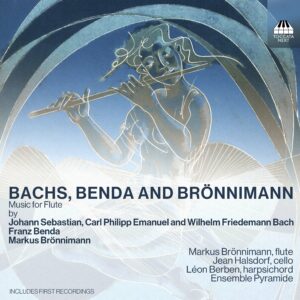
Bachs, Benda and Brönnimann
Four of the composers on this recording met in real life – in Potsdam, in spring 1747. In this album they are reunited, joined by the flautist-composer who brings their encounter to life once more, the Swiss-born Markus Brönnimann. The stylistic contrasts between works three centuries apart serve to accentuate their strengths, the formal elegance of the earlier pieces underlining the expressive liberty of the recent ones. Brönnimann combines the two worlds with his luminous arrangement of one of the best-known of all classical compositions.
Markus Brönnimann, flute
Jean Halsdorf, cello (Tracks 1–3, 7–9, 11–13, 15–18)
Léon Berben, harpsichord (Tracks 1–3, 7–9, 11–13, 15–18)
Ensemble Pyramide (Tracks 4–6, 10)
Markus Brönnimann, flute Barbara Tillmann, oboe
Ulrike Jacoby, violin
Muriel Schweizer, viola
Anita Jehli, cello
Marie Trottmann, harp
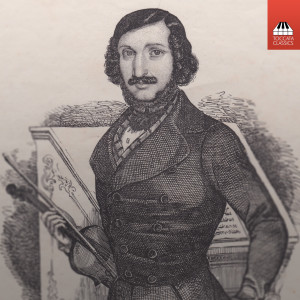
Heinrich Wilhelm Ernst Bundle
- Heinrich Wilhelm Ernst: Complete Music for Violin and Piano, Volume One
- Heinrich Wilhelm Ernst: Complete Music for Violin and Piano, Volume Two
- Heinrich Wilhelm Ernst: Complete Music, Volume Three
- Heinrich Wilhelm Ernst: Complete Music, Volume Four
- Heinrich Wilhelm Ernst: Complete Works, Volume Five
- Heinrich Wilhelm Ernst: Complete Works, Volume Six
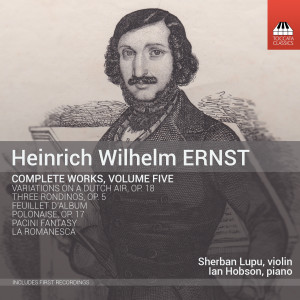
Heinrich Wilhelm Ernst: Complete Works, Volume Five
Heinrich Wilhelm Ernst (1812–65) was one of the leading musicians of his day, a friend of Berlioz, Chopin, Liszt and Mendelssohn, and for Joseph Joachim ‘the greatest violinist I ever heard’. But the popular encore pieces by which Ernst is remembered today represent only a fraction of his output. This fifth CD – in series of seven presenting all his compositions for the first time – shows his mastery of large- and small-scale forms: the Polonaise de Concert and Variations on the National Anthem are grand and brilliant compositions for the concert hall, while the sparkling operatic miniatures and tender arrangements are altogether more intimate.
Sherban Lupu, violin
Ian Hobson, piano
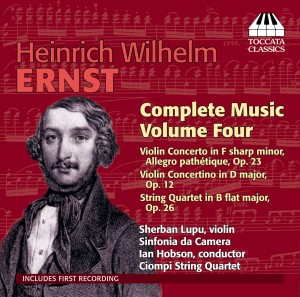
Heinrich Wilhelm Ernst: Complete Music, Volume Four
Heinrich Wilhelm Ernst (1812-65) was one of the leading musicians of his day, a friend of Berlioz, Chopin, Liszt and Mendelssohn, and for Joseph Joachim 'the greatest violinist I ever heard'. But the popular encore pieces by which Ernst is remembered today represent only a fraction of his output. This fourth CD — in a series of seven presenting all his compositions for the first time — contains some of his most important compositions: an early Concertino with a melancholy slow movement and charming waltz finale; the fiendishly difficult Concerto that had a deep influence not only on Liszt's Piano Sonata but also the Brahms and Sibelius violin concertos; and the late String Quartet, with echoes of Beethoven and Mendelssohn and an inwardness, charm and energy all of its own.
Sherban Lupu
Ciompi String Quartet
Sinfonia da Camera
Ian Hobson
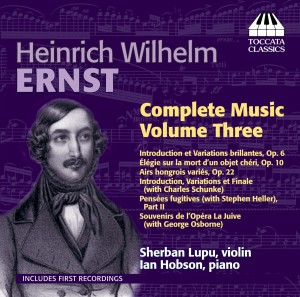
Heinrich Wilhelm Ernst: Complete Music, Volume Three
Heinrich Wilhelm Ernst (1812-65) was one of the leading musicians of his day, a friend of Berlioz, Chopin, Liszt and Mendelssohn, and for Joseph Joachim 'the greatest violinist I ever heard'. But the popular encore pieces by which Ernst is remembered today represent only a fraction of his output. This third CD — in a series of seven presenting all his compositions for the first time — shows the full range of his creativity and charm. The Élégie sur la mort d'un objet chéri is written in his most moving and melancholy vein, and the Airs hongrois variés push the virtuoso violin to its absolute limits. Between these extremes lie the lyricism of the Pensées fugitives, the inventiveness of his treatment of two Halévy operas and the high spirits of his fantasy on a Strauss waltz.
Sherban Lupu, violin
Ian Hobson, piano
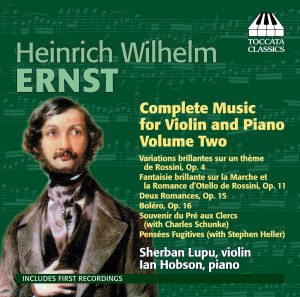
Heinrich Wilhelm Ernst: Complete Music for Violin and Piano, Volume Two
Heinrich Wilhelm Ernst (1812-65) was one of the leading musicians of his day, a friend of Berlioz, Chopin, Liszt and Mendelssohn, and for Joseph Joachim 'the greatest violinist I ever heard'. But the popular encore pieces by which Ernst is remembered today represent only a fraction of his output. This second CD — in a series of six presenting his complete violin works for the first time — combines brilliant display and expressive melody: the Otello Fantasy and Rossini Variations show Ernst developing Paganini's inheritance, and the Boléro, Two Romances and Pensées fugitives show why he was such a favourite in Parisian salons.
Sherban Lupu, violin
Ian Hobson, piano
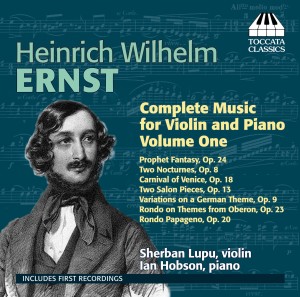
Heinrich Wilhelm Ernst: Complete Music for Violin and Piano, Volume One
Heinrich Wilhelm Ernst (1812-65) was one of the leading musicians of his day, a friend of Berlioz, Chopin, Liszt and Mendelssohn, and for Joseph Joachim 'the greatest violinist I ever heard'. But the popular encore pieces by which Ernst is remembered today represent only a fraction of his output. This series of six CDs presents his complete violin works for the first time, revealing one of the instrument's most accomplished and memorable composers. The first disc shows him in a range of moods, from the mystery and grandeur of the Prophet Fantasy and the Chopinesque poetry of the Two Nocturnes to the bizarre whimsy of The Carnival of Venice and infectious high spirits of the Rondo Papageno — the nineteenth-century virtuoso violin both in introspective melancholy and at its most dazzlingly flamboyant.
Sherban Lupu, violin
Ian Hobson, piano
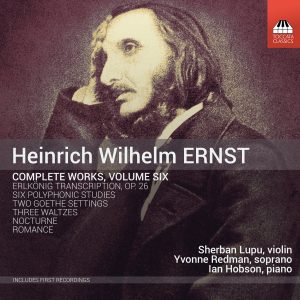
Heinrich Wilhelm Ernst: Complete Works, Volume Six
Heinrich Wilhelm Ernst (1812–65) was one of the leading musicians of his day, a friend of Berlioz, Chopin, Liszt and Mendelssohn, and for Joseph Joachim ‘the greatest violinist I ever heard’. This sixth album – in a series of seven presenting all his compositions for the first time – begins and ends with some of the most difficult music for solo violin ever composed: Ernst’s Six Polyphonic Studies and his transcription of Schubert’s song, Der Erlkönig. Between them comes less familiar fare: five Schubertian piano pieces, and two settings of Goethe.
Sherban Lupu, violin Tracks 1-12, 20
Yvonne Redman, soprano Tracks 18-19
Ian Hobson, piano Tracks 13-19
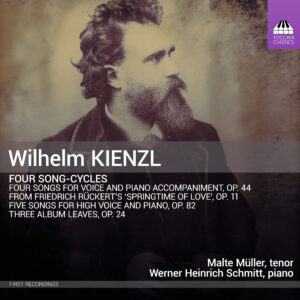
Wilhelm Kienzl: Four Song-Cycles
The Austrian composer Wilhelm Kienzl (1857–1941) – also a pianist, conductor, musicologist and writer on music – enjoyed the esteem of his contemporaries particularly for his vocal music. But his star has waned over the past century, and only a handful of his 238 songs have had recent recordings. In style they range from the simple and folk-like to the dramatic and quasi-operatic; their harmonic world likewise embraces both the diatonic and chromatic, with hints of the influence of Schubert, Schumann, Brahms, Wagner and a foretaste of later composers. The four song-cycles recorded here treat the grand themes of life: love, loss, death and man’s interaction with nature.
Malte Müller, tenor
Werner Heinrich Schmitt, piano
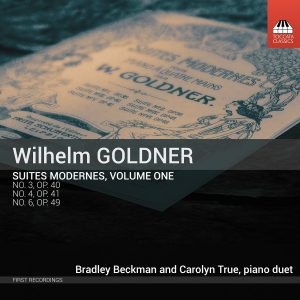
Wilhelm GOLDNER: Suites Modernes, Volume One
Wilhelm Goldner (1839–1907) was one of the many composer-pianists who populated European musical life in the nineteenth century. Born in Hamburg, six years after Brahms, he trained in Leipzig and made his name and his living in Paris, where his attractive and easy-going music became a favourite of the salons. His first Suite moderne for piano duet, written in 1875, proved so popular that his publisher asked for more, and over the next twelve years Goldner composed five further Suites modernes. Although all six were reprinted in 1904 (by Universal in Vienna, no less), they have long since slipped from sight, and these first recordings restore their charms to modern audiences.
Brad Beckmann and Carolyn True, piano duet
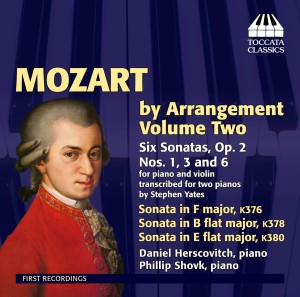
Mozart by Arrangement, Volume Two
The violinist and conductor Andrew Manze recently remarked that the six violin sonatas published as Mozart's Op. 2 in 1781 might also be effective as sonatas for piano duet. The Australian composer Stephen Yates has taken him up on the idea, adding six sparkling new two-piano sonatas to the single original one that Mozart himself produced.
Phillip Shovk, piano
Daniel Herscovitch, piano
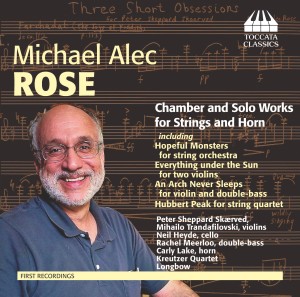
Michael Alec Rose: Chamber and Solo Works for Strings and Horn
In 2004 the American composer Michael Alec Rose (born in 1959 in Philadelphia) met the English violinist Peter Sheppard Skærved. That meeting sparked off a productive friendship: Rose has since written a number of works for Sheppard Skærved and his musician colleagues, pieces marked by striking emotional directness, balancing warm lyricism and mordant wit.
Michael Alec Rose, bell
Peter Sheppard Skærved, violin, director
Mihailo Trandafilovski, violin
Morgan Goff, viola
Neil Heyde, cello
Kreutzer Quartet, string quartet
Rachel Meerloo, double-bass
Carly Lake, horn
Longbow, ensemble
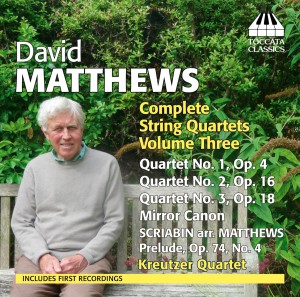
David Matthews: Complete String Quartets, Volume Three
The American critic Robert Reilly described the music on Volume One of this cycle of the complete string quartets of David Matthews (b. 1943) as 'some of the most concentrated, penetrating writing for this medium in the past 30 years or more. It is musical thinking of the highest order and quartet writing in the great tradition of Beethoven, Bartok, Britten, and Tippett'. This third CD in the series presents the first three works in the cycle — the Second influenced by The Who and Velvet Underground — together with an early contrapuntal study and the first of Matthews' arrangements for string quartet.
Kreutzer Quartet, string quartet
Peter Sheppard Skærved, violin
Mihailo Trandafilovski, violin
Morgan Goff, viola
Neil Heyde, cello
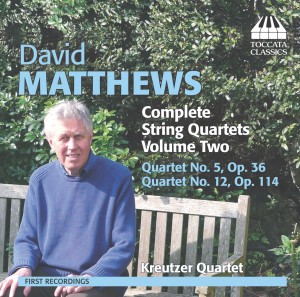
David Matthews: Complete String Quartets, Volume Two
The American critic Robert Reilly described the music on Volume One of this cycle of the complete string quartets of David Matthews (b. 1943) as 'some of the most concentrated, penetrating writing for this medium in the past 30 years or more. It is musical thinking of the highest order and quartet writing in the great tradition of Beethoven, Bartok, Britten, and Tippett’. This second CD in the series presents the Fifth Quartet (1984) and the most recent, Quartet No. 12 (2009–10).
Kreutzer Quartet, string quartet
Peter Sheppard Skærved, violin
Mihailo Trandafilovski, violin
Morgan Goff, viola
Neil Heyde, cello